
- A-Z |
- CALENDAR |
- CONTACT |
- DIRECTORY |
- MAKE A GIFT |
- SAKAI |
- APPLY ONLINE
 TCWeb allows students to check grades, view schedules and access other information online.
https://my.tusculum.edu
TCWeb allows students to check grades, view schedules and access other information online.
https://my.tusculum.edu
Below are links to a variety of statistical information about Tusculum College compiled by the Office of Institutional Research. Please click on the description to view the corresponding chart or table
Purpose: The purpose of this survey is to
evaluate the effectiveness of the Virtue Competencies for developing
and enhancing the citizenship skills of our students. The results
of the analysis of the data will be used to make curricular changes
for continuous program improvement.
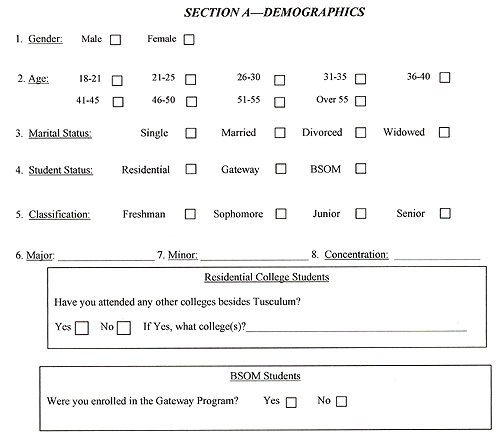
Section A contains demographic data. Section
B addresses the competency of Self-knowledge while Section
C focuses on Civility. In the latter two sections, Section
D emphasizes Ethics of Social Responsibility while
Section E addresses active involvement in civic
and community-related activities.
Directions: Please check the box that best represents your position.
(Note: To see the results of each question in sections B-D, please
click on that question. To see the composite scores of each of
these sections, click on the section title.
The two questions below are to be answered in sections B, C, and
D.

SECTION
B
SELF-KNOWLEDGE: THE EXAMINED LIFE
1.
Examine your own history as you try to understand others.
2.
Record significant life events and your feelings about these events
(e.g. photos, journals, etc.).
3.
Examine your feelings and thoughts about ethical issues.
4. Use personal
strengths and values to contribute to civic causes.
5. Develop goals
that fulfill personal satisfaction and contribute to society.
6. Modify your
personal goals when needed to help enhance the common good.
7. Use what you
have learned about yourself and others in dealing with classmates.
8. Share personal
experiences and values with others to help them develop personal
and ethical perspectives.
9. Participate
in civic relationships as an extension of self-connectedness of
all people.
10. Use knowledge
about personal limitations to guide participation in civic causes.
1. Develop
awareness that differences are inevitable and valuable.
2. Participate
with peers in a sensitive manner-verbally and non-verbally.
3. Attempt to resolve
disagreements with peers and family members.
4. Take a positive,
supportive attitude in dealing with people.
5. Demonstrate
appropriate social conventions and grace in various settings.
6. Help others
develop better personal skills.
7. View controversy
as an integral part of a group's attempt to find an effective
means of implementing a common purpose.
8. Develop strategies
for dealing with strong emotional reactions and behavior of others.
9. Reflect on how
your actions and words will influence the reactions and behavior
of others.
10. Listen attentively
to the issues of others with different perspectives to gain insight.
SECTION D
ETHICS OF SOCIAL RESPONSIBILITY
1. Demonstrate
commitment to balancing ethical demands of individuals and the
community understanding that action in one area may have consequences
in another.
2. Use appropriate
speech and action in both private and public spaces.
3. Participate
in the democratic election process.
4. Address issues
of cultural differences and diversity with sensitivity.
5. Engage in
discussions for visioning future improvements for a community.
6. Attempt to
develop communication skills with diverse factions in groups.
7. Listen intently
with the purpose of engaging all members of groups in discussions
and interactions.
8. Participate
in community action groups to enhance the common good.
9. Address ethical
problems to initiate change in a responsible manner.
10. Consider the
cultural and socio-economic differences of others before acting
and speaking.
SECTION E
Check all the civic and community-related activities you have actively participated in during the past year. Then circle the frequency of your participation based on a scale of 1 to 5 with 5 representing activity occurring on a daily basis, 4 - a weekly basis, 3 - a bi-weekly basis, 2 - a monthly basis, 1 - a yearly basis. Your responses should reflect active participation which implies more than attendance at an event (for example, attending a ballgame in which your child participates would not be considered active participation). However, if you serve as a referee or coach for Little League, that would be considered active participation. Active participation for charity and other types of volunteer work goes beyond donating funds to that charity.
a. Church-related involvement (e.g. Sunday School
or VBS Teacher, Church Officer, Music Ministry, Mission Trips)
b. Youth Clubs (e.g., Boys and Girls Club, Scouts, YMCA, Youth
Builders)
c. Children's Activities (e.g., Toys for Tots, Treasure Chest
for Children)
d. Health Advocacy Groups (e.g., ACS, March of Dimes, MS Walks)
e. Housing/Homeless Advocacy (e.g., Habitat for Humanity, Johnson
City Homeless Coalition)
f. Community Beautification Programs (e.g., Keep Greene Clean,
Adopt-a-Mile)
g. Public/Private K-12 School Activities (e.g.,PTA, tutoring,
guest lecturing, W.O.W)
h. Athletic Organizations (e.g., Little League or clinic coaching,
booster clubs, refereeing)
i. Democratic Processes (e.g., Party fund raiser, local governance)
j. Civic Organizations (e.g., United Way, Optimist, Rotary, Shriners)
k. Environmental Conservation (e.g., Sierra Club, Nature Conservancy,
Ducks Unlimited)
l. Other Volunteer Work (e.g., Visitation at nursing homes or
working with homes for children,CASA, Salvation Army, hospital
volunteer) please specify
Self-Knowledge
Civility
Ethics of Social Responsibility
TUSCULUM COLLEGE
1-800-729-0256 • 423-636-7300
60 Shiloh Road, Greeneville, Tennessee 37743
webmaster@tusculum.edu
© 2009, Tusculum College
